
Boxed Assemblage - Façade
Over the course of my boxed assemblage work, a few pieces were prescient and transitional. Façade, from 1998, is one of them.

Preface
I find it difficult to talk about my early work. I’m sure this is a common malady for visual and performing artists who are typically uncomfortable speaking about their contemporaneous pieces.
When looking upon early work, an artist may see paths not taken and unfulfilled ideas, and who truly wants to revisit regrets? There’s little incentive to return to distant creative artwork unless it may still resonate with your present mindset. This post was initially going to be about one of my very first boxed assemblages from 1990, but as a way of easing back into the difficulty of speaking about my earliest work, I thought I would first discuss this piece from 1998. This reverse chronology seems suited to my art, which is more circuitous than linear.
Description
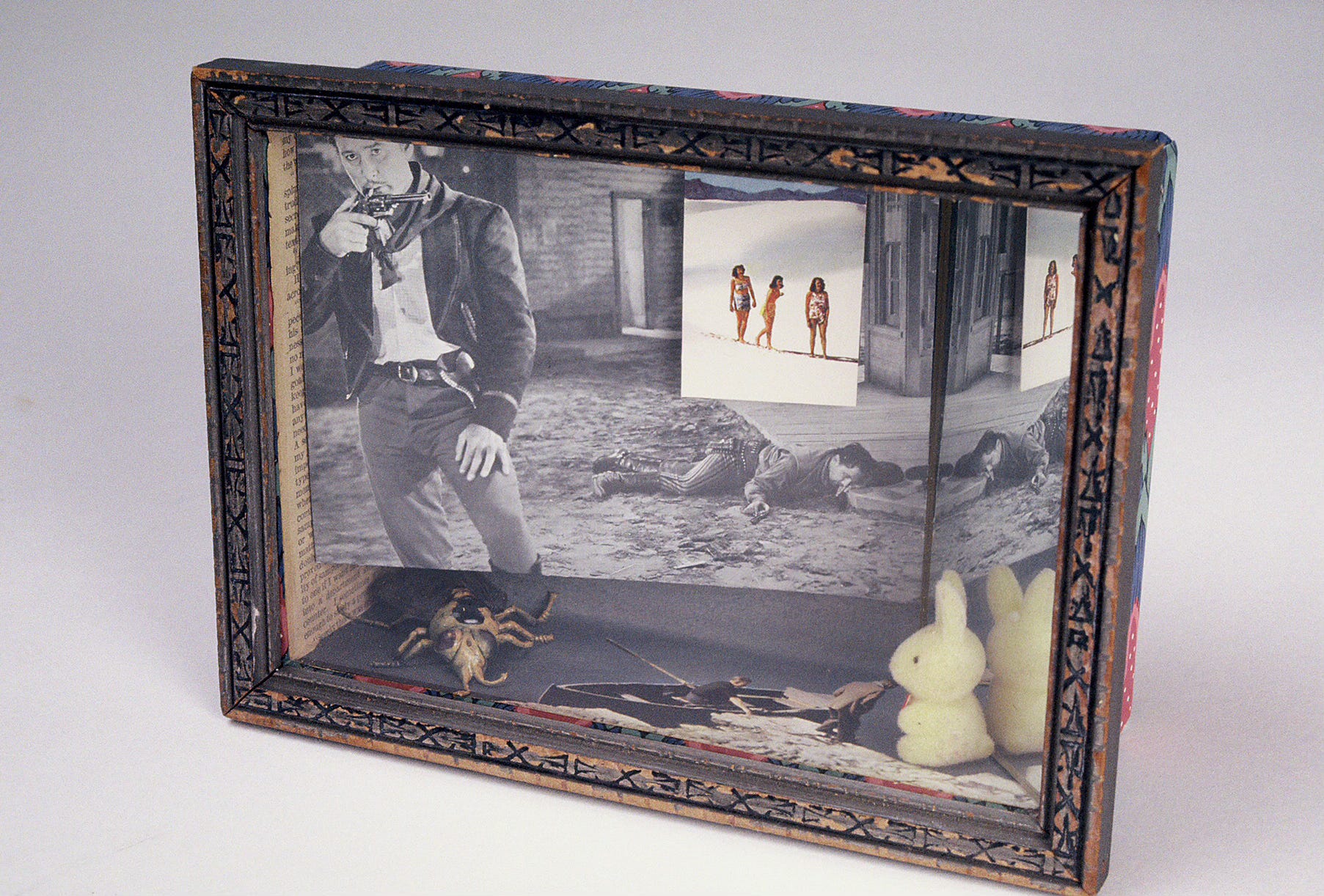
This small piece, roughly 5” tall, 6” wide, and 2” deep, is framed with a somewhat battered wooden frame with an abstract pattern along the front face. The back panel, which is placed at an angle front-to-back, features a black-and-white movie still from a 1940s Western. In the still, a gunman stands in a semi-relaxed pose, holding his pistol up to his chin as he looks directly into the camera. In the background, another gunman lies on the ground, presumably just shot by the standing gunman. Floated above the top right of this photo is a color photo of three women standing on white sand dunes. The right corner of this box is a mirror panel, angled to reflect the movie still photo. In front of this mirror is a yellow fuzzy bunny rabbit figure seated upright. In the opposite corner, peeking out from beneath the movie still, which doesn’t quite reach the bottom of the box, is a plastic beetle. The left wall of the box is covered with a page of text from a magazine story but is mostly concealed by the background photo. The bottom of this piece is a faded color photo of a man maneuvering a small boat from the shore with a view of the sea's horizon.
Thoughts
The shorthand story of Façade is that, in stark contrast to its relatively minimal number of images, most of my previous work was composed of an overabundance of them. This is why it’s a marker for transition, as it opened up a different way of creating my boxed assemblages. And because it closely tracks the way I presently work, you could say it was prescient. To say something is prescient is always an observation in hindsight, and obviously, at the time of its creation, I hadn't been thinking that this piece would be how I would work ten years into the future. We tend to say something was prescient as a distinction, a way of saying with astonishment, “Hey, look at that. It foretold the future.” And Façade does cause me to marvel at its asynchronous nature.
I don’t have a good grasp of what I was thinking at the time I created Façade, other than wanting to make a smaller, more concentrated, and simpler piece, which I had done with one other with a similar form factor, Abomination, that same year. At the time, I was working on my magnum opus, the ten-piece series Anatomy Lesson, which would take two years to complete, so I’m sure I simply gave myself the latitude to make a few one-offs, taking a break from the demanding work of that series. I suppose this would be akin to a novelist taking a break to produce a few short stories. In hindsight, there appeared to be a shift in focus on what I wanted to accomplish with these boxed assemblages. But there may be more in common between Façade and Anatomy Lesson in that both mark a shift from earlier work in their thematic use of imagery. The earlier work tended to be an explosion of images, and that in itself was the theme. The work produced since 1998 has become more focused and found a calmer, more poetic association with the images. Façade, with forced minimal use of materials, evokes poetic imagery in the same way that a poem of few words can depict a scene or state of being as well as a multi-page narrative.
Also, remarkably close to my present-day work are the storytelling patterns that form out of the balance of characters, and the unbalanced architecture and play upon expectations. All these things are precisely how my current work comes to life and why I look back fondly on this work, even though I don’t remember what my thoughts were at the time, other than to say that I’m sure I was responding intuitively to the images and their careful arrangement.
When I attended the retrospective exhibit of Joseph Cornell’s work at the Peabody–Essex Museum in Salem, Massachusetts, I saw, for the first time, a few of his earliest pieces and was surprised to discover that he had gone through a similar stylistic development.
Note: This piece is no longer in my possession and was created before the time when I began to take extensive photo documentation of my work. Consequently, I have only this one photo to share with you.